
Serious incidents rarely occur because organisations were unaware of their hazards, they occur because critical risks were not clearly identified, owned, tested, or governed. A well-designed critical risk program is one of the most important safeguards an organisation has against catastrophic events, yet many programs look robust on paper while failing in practice. When accountability is unclear, controls are assumed rather than verified, and critical risks are not visible to senior leaders, organisations are left exposed to low frequency, high consequence events. This blog explores key red flags that indicate where critical risk programs break down and why getting the fundamentals right is essential.
1. You have not defined accountability for your critical risks and controls.
When accountability is unclear, critical risks tend to fall between roles, leading to assumptions that “someone else” is managing them. This weakens control ownership and reduces the likelihood that controls are actively monitored and maintained. In practice, unmanaged accountability often only becomes visible after a serious incident or near miss.
2. You are not reporting your critical risks upwards to the executive or board.
If critical risks are not regularly visible at executive or board level, leaders cannot exercise effective oversight or make informed resourcing decisions. This creates a disconnect between operational reality and strategic governance. Over time, this undermines due diligence and exposes the organisation to regulatory and reputational consequences.
|
|
|
|
| Strengthen your Critical Risk Program with expert support with our Critical Risk Services |
Strengthen Your Risk Understanding with our Process Safety Due Diligence for Executive Training |
Explore our Process Safety Consulting Services |



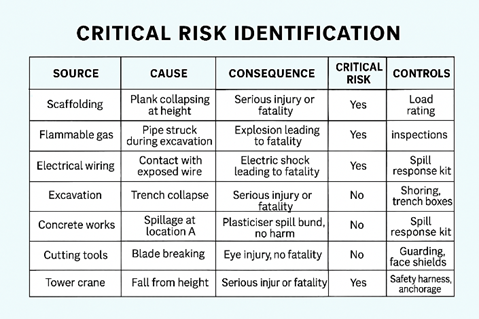
3. There has been no structured formal process to identify your critical risks.
Without a structured identification process, critical risks are often defined inconsistently or based on historical knowledge rather than credible hazard analysis. This increases the likelihood that high consequence, low frequency events are missed. Informal approaches also make it difficult to demonstrate that risks have been systematically identified.
4. You don’t have an assessment process of your critical risks to determine if they are adequately managed.
Failing to assess critical risks means the organisation cannot be confident that controls are effective or sufficient. Risks may appear “controlled” on paper while degradation, gaps, or over‑reliance on weak controls go unnoticed. This creates a false sense of security and delays corrective action.
5. Your critical risks have not been localised to specific sites and assets.
When critical risks are treated generically, site specific hazards and control weaknesses are easily overlooked. Differences in plant condition, operating context, or workforce capability are not reflected in risk management. As a result, controls may be inappropriate or ineffective at the point of exposure.
6. You are not auditing or testing the controls.
Controls that are not routinely tested cannot be relied upon to perform when needed. Over time, controls can degrade due to changes, maintenance issues, or behavioural drift. Without verification, the organisation is effectively assuming controls will work rather than knowing they will.
7. Your program does not assess and document if you have taken all practicable steps to manage each critical risk.
If “all practicable steps” are not explicitly assessed and documented, the organisation may be unable to demonstrate compliance with legal and regulatory expectations. Demonstrating that you are taking all practicable steps to manage your critical risks requires you consider what is good practice, what is mandated by codes and standards and are there any other controls that could have a measurable reduction on your risk.
To help you assess your current approach, we’ve developed a practical Critical Risk Program Self-Evaluation Tool. This workbook is designed to help you identify gaps, prioritise improvements, and strengthen your overall risk management framework.

Ready to take your process safety strategy to the next level?
Our critical risk services support organisations in identifying, assessing, and assuring their most significant risks. Through structured critical risk identification, detailed risk assessment, and ongoing critical control assurance, we help ensure that high consequence risks are clearly understood, effectively managed, and supported by reliable controls. Find out more about our Critical Risk Identification, Critical Risk Assessment, and Critical Control Assurance services.